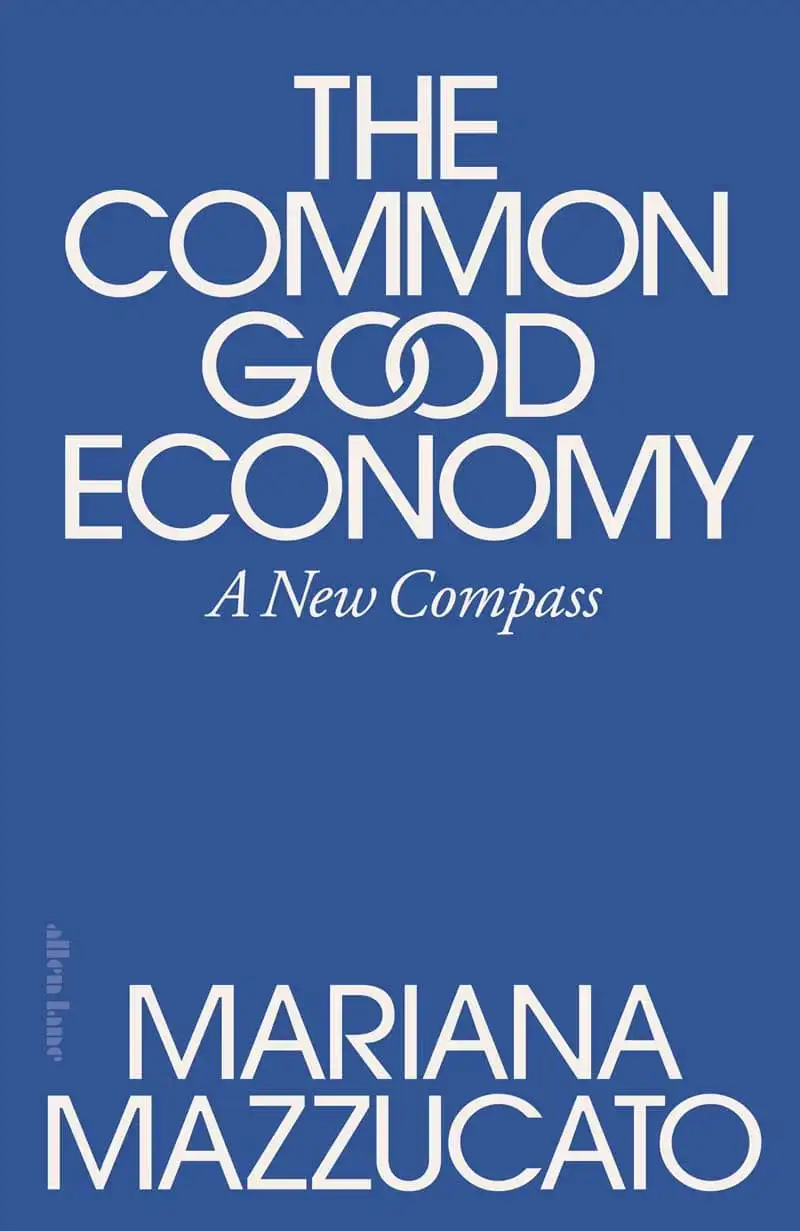
The Common Good Economy: A New Compass
In her latest book, published in June 2026, Mazzucato turns to a question that is as much philosophical as economic: what do we actually mean by "the good," and how should it shape the way we organize our economies?
Her starting point is a critique of how mainstream economics has handled this question for centuries. Concepts like public goods or the commons have almost always been treated as afterthoughts — corrections applied only once markets or governments have already failed. This, she argues, locks policy into a permanently reactive mode: societies keep patching problems instead of deliberately building the economies they actually want.
Mazzucato's alternative is a "common good compass" — a practical framework for governments and businesses to design purposeful economic relationships from the outset, rather than repairing the damage afterward. Building on her earlier work on the entrepreneurial state and mission-oriented policy, she makes a case that is distinctly philosophical in spirit: how we pursue collective goals — through participation, reciprocity, and collective action — matters just as much as which goals we choose to pursue. Process and value are inseparable.
The book sets out five dimensions along which this compass operates, from clarifying purpose in decision-making to expanding transparency and the sharing of knowledge, and grounds the argument in real-world cases — from the governance of water to reforms in public procurement and finance.
Arriving nearly 250 years after Adam Smith's The Wealth of Nations, The Common Good Economy can be read as a direct challenge to the idea of the "invisible hand": rather than trusting private self-interest to generate public good, Mazzucato asks what it would take to make the common good the explicit, shared compass by which an economy is designed.